


The smallest floor-standers in Max Magri’s lineup may look inconspicuous, but once properly set up and driven by the brand’s own fantastic Class A integrated Shinai, they offered a surprisingly powerful and engaging musical spectacle. Let me present to you GrandiNote MACH2.
Introduction
I have known Max Magri for years. We met a long time ago when the core of his lineup was Class A ‘magnetosolid’ integrated and power amplifiers, as well as matching preamplifiers. I listened to his components for the first time in Munich, at the HiFi Delux Show that accompanied High End Show every year, but was held in the Marriott Hotel at the same time as the main event. Even though I didn’t speak Italian and Max’s English, as he used to say, was ‘no good’, music and the excellent sound delivered by his creations spoke for themselves and acted as sort of translators between us.
In case you haven’t noticed or known, basically ever since that first encounter, I have been, and still am, a vivid fan of everything GrandiNote. All it takes is for you to check my reference system listed below every review. You will find there MACH4 speakers, Shinai integrated, and Celio MK IV phono stage that have been key elements of my setup for years, and I still feel no urge to replace them. It doesn’t mean that these are the best of their kind, but they do offer excellent performance and, importantly, also ‘my sound’. I also had a chance to review and listen to several other components, and while my expectations were always high, none of them ever let me down. So full disclosure – while a tube aficionado, I am also the Italian brand’s huge fan! It shouldn’t be that much of a surprise once you listen to Max and his story. His first designs featured tubes, and he loved their sound. Only later, he developed his proprietary ‘magnetosolid’ technology (a solid-state, to be clear), which he found sounded very much like tubes, but that offered more power and exerted better control over speakers, making them more versatile.
37 watts, that Shinai and the number of other GrandiNote’s amplifiers offer may not seem like much, but over all these years, there were two, maybe three cases of speakers I tested, that the Italian integrated wasn’t able to drive to their full capability. In other words, despite not offering hundreds of watts, these amplifiers get the job done in most systems, offering an amazingly resolving, pure, and yet naturally warm and highly engaging sound.
More or less at the time we met, Max started to expand his lineup. First, he added two sources – the Celio phono stage for vinyl lovers, and Volta DAC/streamer (and their latest versions are the only two sources in the lineup still today) for those who prefer audio files. Later, a bit surprisingly, perhaps, he added loudspeakers. Again, he went against the grain, so to speak. These are not your usual designs – no bass-reflex, no close cabinets, no horns (waveguides – yes). These are S.R.T. or Semi Resonant Tube designs. They feature a number (depending on the model) of full-range small drivers and one or more tweeters. Oh, one more important (!) thing – they feature no crossover! The whole range is called MACH, which in technical terms represents the ratio of an object’s speed to the speed of sound, and the name is always accompanied by a number. My pair is MACH 4; the tested ones are MACH2, but there is even a MACH16 model. The number tells you how many woofers are featured in the said model. There are some special models, such as MACH2 Estrema – still two woofers, but a much larger cabinet than the regular, tested MACH2; there is MACH8 XL (8 woofers and really large dimensions); or the latest addition to the range and the top-of-the-line (at least for now), MACH8 Evoluzione.
Some things have changed over the years as the company has evolved (which has been reflected in the name of the latest model). My MACH4 pair comes from the times when the choice of material for the MACH cabinets was aluminum. As a result, each of those, not that large loudspeakers, weighs almost 50 kg. Later, GrandiNote had a brief affair with carbon fiber, but today most models use MDF as the basic cabinet material. The exception being the latest MACH8 Evolutione that benefits from past experiences and combines aluminum with carbon fibre. I can’t wait to listen to them (hopefully) in the near future, as I have huge expectations for them. For now, though, let’s focus on the other end of the range, the tested MACH2.
Design & Features
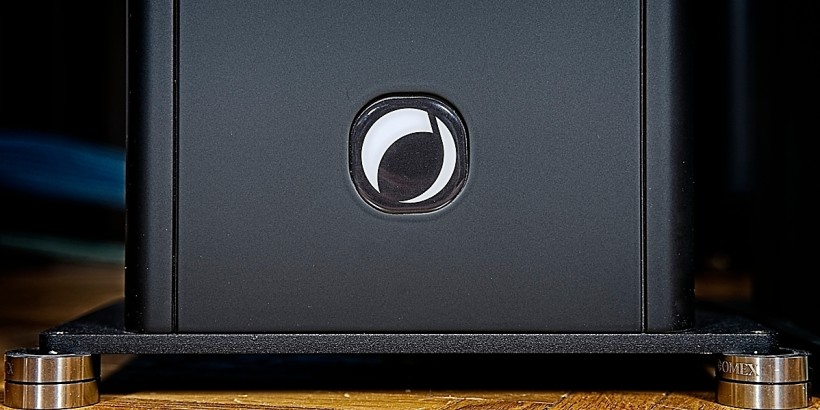
Let’s start with the basics. MACH2 are floor-standing loudspeakers measuring 116x24x23 cm, so while quite tall, their footprint (slightly increased by an additional base one installs spikes in), and nicely rounded corners make them pretty sleek. The cabinets are made of 22 mm-thick MDF and are beautifully finished. The tested pair was black with matte, or rather a sort of satin finish. Alternatively, one can choose something called Tulip Stone in either matte or glossy finish (depending on the finish, price may differ). The whole construction rests on three spikes, two in the front and one in the back, with the latter being a touch shorter. The front of the speaker holds three drivers, two 130 mm woofers that are unfiltered and unequalized, or in other words, no crossover whatsoever. Between these two sits a 25 mm silk dome tweeter, or more of a super-tweeter, as it starts to operate around 12,8 kHz. This driver is accompanied by a (protective – still not a crossover) capacitor, and, like both woofers, sits in a waveguide lodged quite deep in the front panel. The rear panel features high-quality WBT nextgen single speaker binding posts and a horizontal slot close to the base of the speaker.
The key to this crossover-less design is what Max calls ‘a mechanical crossover’, or the S.R.T. cabinet. Instead of dividing the signal between drivers electrically in a crossover, GrandiNote achieves the same via the mechanical properties of specially designed cabinets. Does it work? Based on my hands-on long-time experience with MACH4, it does, it really does! To finish this short ‘technical’ part, let me add that these are 8 Ω (nominal) speakers with a high sensitivity of 92 dB. That means you can partner them even with a low-power (tube or solid-state) amplifier of your choice, as long as it can keep up in terms of performance level with those ‘entry-level’ MACH2 loudspeakers by GrandiNote.
Sound
As I’ve already mentioned, I’ve been using MACH2’s larger siblings, MACH4 (aluminum version), for years. They are not only great performers, but also particularly versatile loudspeakers. Their sensitivity of 95 dB and 8Ω load make them suitable partners for almost any amplifier. Whether a 2x3W 2A3 tube amp, 300B SET, 37 W Class A solid-state, or a powerful, transistor AB Class beast such as, say, Marton Opusculum Reference 3 (see HERE), their performance is a reflection of the amp’s class, not the output power. And when paired with a good amplifier, the MACH4s’ sound is brilliant, which I, as a fan of single-driver loudspeakers, attribute in large part to the lack of crossover. I got used to the sound quality and the ‘dissonance’ between how they look and how they sound. MACH4 managed to surprise many people, though, who visited my room, with the scale, transparency, and immediacy of the sound, but most of all, with the bass performance. The 5-inch (roughly 130 mm) drivers don’t scream ‘powerful bass’, but combined with the S.R.T. cabinets, they do deliver. They do not have quite the mighty punch of my Ubiq Model Ones, which feature large 12-inch woofers, as the lowest notes delivered by MACH4 do not carry quite as much weight and energy, yet the tightness, speed, and focus are excellent, much better than with most speakers I know (regardless of the design).
MACH2 speakers are smaller. I mean, they do not differ that much in terms of size, just 15 cm shorter and 1 or 2 cm smaller in depth and width. They are significantly lighter because MDF replaced aluminum, but that’s not something you can see. They look and feel smaller, because instead of 4 woofers they feature ‘only’ two that accompany a single tweeter. Plus, all the drivers in the tested model sink much deeper into the thick front panel. All in all, these are elegant in their form and finish, sleek speakers that easily blend with the room’s decor, almost disappearing from view, so one may expect a sort of bookshelf speaker performance.
And do they actually? Well, let me tell you a cautionary tale first. It so happened that the speakers arrived without spikes – they must have gotten lost at some point before the speakers arrived at my place. I didn’t have any other matching spikes to use with MACH2, and so I placed them, the same as I do every day with my MACH4, on Acoustic Revive quartz platforms instead. As I was lazy, I hooked them up with the setup I’d used in the previous test, with Circle Labs P300 & M200 preamp/amp combo and Soyaton Benchmark RCA speaker cables. What I got was basically a ‘bookshelf speaker sound’ with very little bass. Sure, I didn’t expect so much punch as with the Ø Frigg 2 tested directly before GrandiNote, but the lower part of the band almost completely disappeared with the Italian speakers. It was obvious (to me, at least) that it wasn’t right, that I had some work to do. I won’t bore you with the whole story, but let me offer you a short version. The bottom line is that had I given up at this point, it would have been my loss, since after introducing some changes to the setup to optimize the performance of Italian speakers, the results were stunning! First of all, I removed the platforms and replaced them with three Omex Symphony 2S anti-vibration feet (you can check out the review HERE) per speaker, and that alone did most of the job of bringing the bass (and what a bass it was!) back. Still, later, which was a natural choice, I switched Circle Labs set to GrandiNote Shinai integrated, and finally, I replaced Soyaton Benchmark speaker cables (you can check out the review HERE) with my other reference set, WK Audio TheRAY Exclusive (you can check out the review HERE). That’s the setup I ultimately used to assess MACH2 combined with LampizatOr Poseidon, J.Sikora Standard Max, and Transrotor Strato as sources of the signal. And it sounded excellent!
Once I found the ‘right’ setup, and let me emphasize once more that the anti-vibration feet (as I didn’t have spikes) did most of the job, the sound MACH2s served me was a completely different beast than before the changes. It was full, rich, with colorful, smooth, highly energetic, and open midrange, vivid, open, vibrant treble, and proper bass support. ‘Proper’ means here that the whole presentation was well-balanced, as there was as much bass as needed. It wasn’t shy, but it was never exaggerated either. It seemed to me that no matter the music genre, the tested speakers delivered the right amount of bass. That’s why it was rarely an element catching my attention, but I (almost) never really lacked it either.
At the beginning of the listening sessions, I did play some tracks with really deep electronic bass, and these, as delivered by MACH2, were surprisingly tactile, so to speak. I could hear how deeply they extended, and even felt them in my bones. Again, it wasn’t quite as powerful as with speakers with large woofers, and yet, for the size of the cabinet and, even more so, drivers, it was astonishing! On the other hand, when I played the latest album by John Scofield and Dave Holland, Memories Of Home, GrandiNote speakers gave me a really great insight into the intricate details of the performance of both musicians and the sound of their instruments. This time, however, the double bass did not sound quite as rich, quite as ‘woody’ and deep as it did with Ubiq speakers or even with MACH4. It just lacked the ultimate energy saturation, or ‘weight’, when the lowest notes were played. I later confirmed the observation when listening to Isao Suzuki Trio’s Blow Up. His double bass on this recording goes incredibly deep, and with large speakers, you can actually feel it in the deepest part of your body. Admittedly, with MACH2, this impression wasn’t quite as tactile. And yet, it didn’t bother me at all. I would take the precision and control of the lower end over the deepest but ‘boomy’ bass every time. Control, precision, but also excellent differentiation showing me the details of the natural timbre and texture of the instrument – that’s what MACH2 delivered in spades, and I loved it about them.
In a way, MACH2 continued the ‘sound philosophy’ I found in any other speakers made by this brand, which I already knew. They delivered a fast, dynamic, detailed presentation with a high energy level, very good PRAT, and above-average resolution. The ‘detailed’ part in this case meant an abundance of information, including the tiny ones, and not an ‘in-your-face’ approach to their delivery. With all those features, the tested speakers sounded, on the one hand, very familiar, yet a bit different on the other. It was no surprise that compared to the sound I was used to, of the MACH4, the center of gravity of the sound shifted a little up. The surprise was, though, by how little. Also, maybe due to the different cabinet material, the presentation seemed a little ‘freer’ and ‘fresher’. It’s possible that it was just different, and I tried (too) hard to figure out why.
A side note. Max advised me in the past, more than once, to add spikes to my MACH4 for ‘more bass’. I just wasn’t really interested, as I simply loved the quality, tightness, speed, and differentiation of the bass, and the accompanying extension was good enough for me. I thought ‘more bass’ could mean it would go deeper, but at the cost of tightness and speed, and I would hate to hear a rounded and softer lower end. So I never even tried. The MACH2 experience, however, brought the issue up again, and I made a note to myself to later try the Omex feet with my speakers. At some point, I’ll find an occasion to let you know how it went. End of the side note. Now the bass was the most surprising aspect of the MACH2 presentation, considering their size and driver complement. However, it was definitely not the most important or even most impressive part of their presentation. I’ll get back to the midrange soon, as it is the key to these (or any, actually) loudspeakers’ performance, but first, let me complement the upper part of the range, the treble, as it raised my eyebrows more than once during numerous listening sessions. The presentation of the high tones carried high energy, combined with excellent clarity, purity, and yet it avoided brightness or harshness.
The latter feature has to do with an amplifier, as the latter tests proved, and, to a point, with recording quality, but regardless, some metal percussion instruments and cymbals sounded absolutely fantastic with these speakers. It wasn’t as rich and smooth a treble as with my personal favorite tweeters, Dynaudio Esotar, but it came close. The sound was open, with a lot of reverb and long decay (both, whenever recordings allowed it), and those elements enhanced the spatial aspect of the MACH2 performance. Now, let me emphasize that I set up these speakers in a different way than I usually do, with much more toe-in, so that the tweeters’ axes crossed in front of my head.
That changed the way the sound stage was reproduced, but didn’t change the fact that the Italian speakers rendered an amazing stage in terms of both depth and width. So much so that I purposefully selected particularly spatial, mostly live, recordings. Especially the latter sound very engaging with MACH2. Not only the large, open, filled with air sound stage, and imaging are exquisite, but they are combined with the aforementioned high energy of the presentation (a result of no crossover, I guess), excellent dynamics on both, macro and micro levels, fast, well-articulated leading edge, but also proper sustain, and decay, and as a result what one gets is incredibly lively, engaging, very ‘here and now’ performance. Interestingly, I could listen to the GrandiNote speakers for hours without any sign of fatigue. It’s not that common with components with a similar sonic character. What it means in practical terms is that the presentation is very natural. But… let’s circle back to the amplifier choice, because it plays a significant role. I listened to these speakers with several amplifiers. All of my own amps participated in the test – GrandiNote Shinai (Class A solid-state) was the first choice, but I also used the pre+amp combo from Circle Labs (P300 + M200), and ArtAudio Symphony II 300B SET. I also gave a chance to a few other amplifiers that visited my room over the months MACH2 spent with me. The number one choice for the tested speakers, in my opinion, was Shinai with 300B SET in the close second place.
Based on this extensive experience, I would recommend a touch warm, dense-sounding partners for the tested speakers. Class A solid-state, tube amplifiers (preferably, but not limited to, Single Ended ones), or Class D (the analog ones) should be a perfect choice. GrandiNote’s own amps are the obvious choice, but I would rather suggest the wonderful Shinai than the Supremo. Let’s forget the financial aspect for a moment, as the latter is objectively a better device, but sonic-wise it is also more neutral sounding, even more transparent, more resolving, and as a result, the presentation with MACH2 may become a bit ‘too much’, at least for my taste, hence Shinai.
Summary
I was cautiously optimistic before my first listening session with GrandiNote MACH2. When I found an optimal setup, I felt genuine excitement again, and quickly found out that my expectations were easily exceeded. I couldn’t help it – Max Magri’s speakers (at least MACH 2 and 4) may not be the ‘best ones in the world’ (just a standard reminder – no such thing in audio), but they check most of my boxes of a high-quality performance requirements list, and really know how to push my personal buttons. I loved the experience they provided of a lively, spatial, highly energetic and dynamic, but also resolving, precise, open, coherent, and, no other way to put it, natural presentation.
Yes, it is true – they are quite costly for an ‘entry level’ speaker. It’s just that, in the right setup, they deliver sound quality that some other brands offer only with much bigger and much more pricey models. The choice, as always, is yours! Give them a try, particularly if you’re looking for maximum performance in a small to mid-size room – I’d say 14-25 (maybe even more) sqm – and can support them with a classy system. In some smaller rooms, they may be a valid alternative to stand-mounted speakers, as they can offer the same type of disappearing from the room, filling it with music, and, unlike some ‘monitors’, supporting the sound with an impressive, tight, yet juicy, and fast bass. They will repay your trust with a highly immersive, exciting experience, and keep a smile on your face. That’s what they did for me, and so I still haven’t gone back to MACH4, and I am in no rush, no rush at all…
Price (when reviewed):
- Grandinote MACH2: 10.500,00 EUR (incl. VAT) a pair
Manufacturer: GRANDINOTE
Distributor in Poland: Audio Atelier


Associated equipment:
- Digital source: a custom passive server with WIN10, Roon, Fidelizer Pro 7.10, JCAT NET XE, and JCAT USB XE cards with FERRUM HYPSOS Signature power supply, KECES P8 (mono) linear power supply for the server, JCAT USB Isolator
- D/A Converter: LampizatOr Poseidon + Ideon Audio 3R Master Time (USB signal regenerator)
- Analog front end: J.Sikora Standard MAX turntable, J.Sikora KV12 & J.Sikora KV12 MAX tonearms, AirTight PC-3, Audio Technica PTG33 Prestige & LE SON LS10 MKII cartridges, Grandinote Celio MK IV & ESE Lab Nibiru V 5 phono stages.
- Power amplifiers: GrandiNote Shinai, Circle Labs M200, Art Audio Symphony II (modified)
- Preamplifier: Circle Labs P300
- Loudspeakers: GrandiNote MACH4, Ubiq Audio Model ONE Duelund Edition.
- Interconnects: Bastanis Imperial RCA x2, Soyaton Benchmark RCA, Hijiri Million Kiwami RCA, Hijiri HCI-20 RCA, TelluriumQ Ultra Black RCA, KBL Sound Himalaya 2 XLR, NxLT Ether XLR, David Laboga Custom Audio AKOYA USB, David Laboga Custom Audio Digital Sound Wave Sapphire Ethernet
- Speaker cables: Soyaton Benchmark Mk2, WK Audio TheRAY Exclusive
- Power cables: DL Custom Audio 3D-S-AC Connect, LessLoss DFPC Signature, Gigawatt LC-3
- Power: Gigawatt PF-2 MK2 and Gigawatt PC-3 SE Evo+; a custom power line with Gigawatt LC-Y in-wall cable; Gigawatt G-044 Schuko and Furutech FT-SWS-D (R)
- Network: Silent Angel Bonn N8 + Silent Angel Forester F1 + optical LAN isolator
- Racks: Base VI, Rogoz Audio 3RP3/BBS
- Anti-vibration accessories: ROGOZ-AUDIO SMO40 and CPPB16 platforms and ROGOZ AUDIO BW40MKII feet, OMEX Symphony 3S, Franc Accessories Ceramic Disc Slim Feet and Wood Block P