


In audio, there is a thin line between a so-called ‘designer’ product and an ‘audiophile’ product. Some look good, some sound good, and there is the most sought-after category – the ones that combine great looks with ultimate performance. Fram Arte Noir speakers are a ‘designer’ product, no doubt, but the listening tests proved that they are also more than just a ‘pretty face.’ So much more.
Introduction
Not that long ago, I reviewed the Ancient Audio Silver Grand Mono II amplifiers for you (you can find the review HERE). It’s the latest incarnation of the iconic 300B monoblocks developed by Mr. Jarek Waszczyszyn. For me, after many years of admiring the brand from afar, it was a chance to experience its top product firsthand in my room. Those who read the review know that it was a unique experience for me, as these monoblocks offered performance that placed them among the best money can buy. Those who follow the Ancient Audio story surely realize that, apart from the amplifiers and CD players the brand is best known for, Mr. Waszczyszyn developed speakers as well. Models such as Wings and Vintage Ribbon, to name a few, showcased the designer’s talent and knowledge, allowing him to create truly high-end speakers in terms of performance and to match his best electronics.
Later, he turned to smaller active designs, including studio monitors for professionals named Master Oslo. About ten years ago, though, together with some industrial design specialists, he founded a new brand. It was named Fram, and at first, it offered relatively inexpensive active speakers. One of the characteristic features was cabinets made of aluminum. Over the years, the company has evolved, and today they offer passive speakers only, ranging from the medium-priced Fram Midi 150P, through larger Fram Arte, to the quite expensive Fram Arte Noir. Note that all of them are stand-mounted models. To give me a taste of their performance for this review, Fram delivered its top model, Arte Noir, in the Total Black version. Later this year, I’ll get a chance to assess the Midi 150P as well.
It is not that simple to develop an audio component that is not just another representative of its kind but has features that make it stand out from hundreds or thousands of other products available on the market. When it comes to Fram Arte Noir, the first not-that-common feature for the size is their 3-way design. They are pretty large stand-mounted loudspeakers, although they do not come even close to, say Harbeth M40 or other similarly sized beasts. Most potential competitors of similar size available on the market today are 2-way designs, and so is Fram’s own mid-range Arte.  The second feature that differentiates Arte Noir is that, instead of commonly used solutions such as bass-reflex, closed-box, or the much rarer (particularly in monitors) transmission line, this model utilizes a large passive membrane. What makes it truly stand out, though, is the third distinguishing feature, namely its form. That’s what actually catches the eye first. The inspiration is quite clear for any frequent theater visitor; namely, Fram Arte Noir looks a lot like a stage light. It’s about the tall tripod it is placed on, and the way the speaker is mounted on it, which allows the user to point it exactly where needed. Have I mentioned that the make and finish are excellent, stunning, really, as well? Now, I have. Does the performance follow the looks? Keep reading to find out.
Design & Features
I have already mentioned the key features of the tested speakers, and the rest is hidden inside. That is why I decided to ask the best possible source, Mr. Waszczyszyn, to share as many details of the design as he could, and here is what he offered:
„Speakers are the most important and most difficult components of the audio system to design. At first glance, it is very simple – there are some vibrating elements enclosed in a cabinet. In fact, a speaker is somewhat similar in terms of design to a violin, with its sound box and vibrating strings. But remember that despite similar appearances, there is a long way from a Staaga violin to a Stradivarius.
The most visible part of the speaker is the cabinet. It must be visually attractive because speakers are usually looked at more often than listened to. It is hard to deny the reasoning of those who claim that it doesn’t matter how something looks; what matters is how it works. However, my wife (an architect) claims, rightfully, that audio equipment is looked at for 12 hours a day but listened to for only half that time; hence, the look is very important. It is also true that music is an art; it is about emotions. The appearance of the beloved audio ‘toys’ often suggests what the ears should expect to hear. That is why we at Fram strive to perfect the aesthetics of all our designs, making sure that the make&finish are perfect. Also, the deep knowledge of technology and the production processes gives free rein to our imagination. This is how the first Fram speakers were created, from the Mini / Midi / Maxi series. Simple, excellently made aluminum cuboids met the expectations of music lovers of both sexes.
The second series, Midi 120/150, Maxi 150, further refined this concept in the form of excellent, award-winning active designs. However, it turned out that active speakers, although very convenient, limited the choices of more sophisticated listeners. Hence, we returned to the concept of a passive speaker that could play in most audio systems. The speakers were to be sophisticated and suitable for medium and large rooms.
It required adequate bass performance and power handling, which called for proper drivers to achieve that. And those had to be used in some cabinets. When we considered various concepts, I was just finishing a mini car/camper audio set. The limited space on the dashboard required something neat and aesthetically pleasing. I made small speakers in the shape and size of old bicycle lights. When the rest of the Fram team saw them, the concept of a larger speaker in the shape of a classic stage reflector was born. To be honest, I was not convinced by the idea, though.
Fram’s activities are conducted in several locations, which sometimes makes cooperation difficult. However, it also has some advantages, as we can independently refine many ideas. And when I saw the prototypes, designed by Tomek and Adam, my jaw simply dropped. These were large, two-way speakers featuring a large, 24cm Satori woofer and a ring radiator tweeter. We named the speaker “Arte” because it was a fine piece of art. The idea of large, stage-like reflectors turned out great. The enormous work was put in, though, to divide such a complex cabinet into parts and develop individual technological processes. Even the external ribbing was retained, which was derived from enormous heatsinks of stage reflectors. After all, those use 1000W and larger bulbs, and the whole thing heats up horribly.


The shape of the speaker fits perfectly into the atmosphere of the stage; just as the reflector illuminates the stage with light, so does the speaker fill the stage or the room with sound. Let me add that the concept and form of the first “Arte” speaker were recognized and appreciated in the final stage of the “Good Design” utility art competition.
The sound of the first “Arte” was widely acclaimed, but we believed that the speaker’s potential was still not fully utilized. Combining a large woofer with a small ring radiator tweeter was extremely difficult, and the crossover featured as many as 18 components. Yet, we were not completely satisfied with the sonic results. That’s where the concept of a three-way speaker with an additional midrange driver stemmed from. The latter was placed at the bottom of the front panel, replacing the bass-reflex port of the previous two-way speaker. We chose an excellent, though difficult to apply, soft-dome midrange driver with a neodymium magnet. To support the bass woofer, we added a passive membrane to the rear panel.
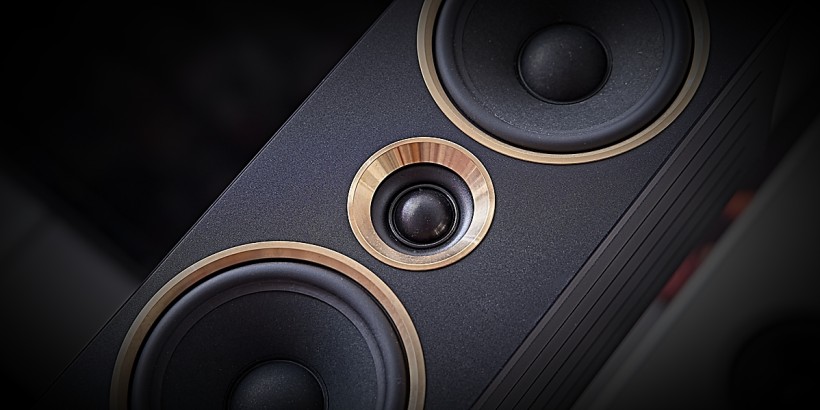
Ultimately, Fram Arte Noir utilizes as many as four drivers, all sourced from the Danish company SB Acoustic. The woofer uses a very powerful neodymium magnet. High magnetic induction in the gap ensures high efficiency, despite the 23 mm long coil. At the same time, adequate damping of the diaphragm is achieved due to induced currents. The coil has a linear excursion of 17 mm, so even at very high volume levels, the coil’s operation remains linear, and there is no compression of dynamics.
Due to the specific nature of the Arte Noir cabinet, it was necessary to modify the driver so that the Thiell-Small parameters could be adapted to the speaker. The aperiodic bass loading is suitable for good reproduction of fast impulses and musical rhythms. The 25 cm active woofer works together with a passive driver. From a physics point of view, this solution is similar to a vented bass-reflex cabinet, extending the frequency response down by half an octave. The operation of both types of cabinets is identical at low levels. However, they work differently at high sound levels. The bass-reflex tunnel has a small cross-section, so to deliver the right acoustic pressure, the amplitude of the sound wave is high, and the air velocity is high. And this is where the problem begins because, at high speeds, the airflow changes from laminar to turbulent and highly disturbed. We can hear it as noise, air whirring, and sound compression.
The passive membrane has a large surface area, larger than the driver. Therefore, even at maximum sound levels, its movement does not exceed a few centimeters, and it does not cause any distortion or compression of the sound attack. Using a passive membrane is more expensive and complicated to implement than a bass-reflex tunnel. Still, because it better reproduces the dynamics of low frequencies, Fram decided to use this solution in most of its speakers, focusing on the best possible sound quality.
The midrange driver also uses a neodymium magnet, which, in addition to high efficiency, has allowed for a significant reduction in the size of the driver. The design is rare; it is a soft dome with a diameter of 60 mm. It operates from 300 Hz to 8 kHz, which allows both crossover frequencies to be moved far away from the part of the band where the human ear is most sensitive to distortion. In the key part of the range, in our speaker, only one driver works instead of two overlapping each other.
The tweeter, in turn, features a ferrite magnet. This is a deliberate design choice, as it gives it a much greater mass, providing a stable base for the fast-moving diaphragm. The diaphragm is also a soft, fabric one. Fixed in the center is another original feature. It makes it closer to a ring radiator than a classic dome. It reduces the length of the delayed acoustic wave at the maximum frequency in the diaphragm by half. As a result, the driver reproduces a bandwidth of up to 40 kHz, rather than 20 kHz, as is typical for a soft dome. The crossover is the third key element of the speaker. Unfortunately, it is very often underestimated. A carelessly designed, overly simplified crossover can ruin the most beautiful features of the drivers and cause the speaker to produce a distorted sound. Properly designed, it has three functions. First, it distributes the electrical signal to three drivers so that each of them operates in its optimal frequency range. Second, it sets the correct frequency response (tone) for the entire speaker. Third, it corrects the time alignment between the drivers.
This issue is very important because most instruments generate sounds in a wide frequency range. Even a double bass, when plucked strongly, generates not only bass but also harmonics across the entire acoustic band. In a three-way speaker such as the Fram Arte Noir, a single quick pluck of a string or a snare drum hit must reach the listener at precisely the same time, even though it is reproduced by three different drivers. Only then will the dynamics of the original sound be preserved. If any part of the range is accelerated or delayed, then the dynamics of the music reproduction are limited. Also, the reproduction of space (reverb) and the location of instruments require perfect coherence of the sound waves over time.
And that is why the development of the Arte Noir crossover proved to be the most time-consuming stage of the design process, involving hundreds of hours of listening tests, minor adjustments, and fine-tuning. The speakers were tested in various rooms, with tube and transistor amplifiers, using acoustic and electric music. During the most critical tests, the sound coming from the speakers was compared with natural instruments (drums, guitar, violin, and human voice).
The crossover design consists of multiple filters connected in series and in parallel. The resulting tweeter filter is a fourth-order one. The midrange driver uses a set of linear and elliptical filters to achieve the appropriate slope steepness. The crossover for the woofer is designed in a similar manner. In addition, during testing, it turned out that depending on the electronics driving the speakers and the acoustics of the room, the sound of the speakers should be corrected. Therefore, the speaker not only offers a three-position switch for treble level adjustment but also for bass level adjustment. It was implemented in the crossover, which is a unique solution.
All these solutions turned the entire crossover into a very complex circuit featuring 17 components, each with precisely selected values, labor-intensive in terms of manufacturing and testing. This is a significant difference compared to typical high-end speakers, where the crossover is often primitive, consisting of only a few components.”
Sound
Before I get to how the Fram Arte Noir speakers sound, let me start with some practical issues. Setting up loudspeakers in a room is not quite as simple a process as it may seem to some. Especially when setting up new, unknown to us. There is the matter of placement that takes into account distances from the wall behind them, the side walls, and the distance from the listening spot. Those distances depend on the size of the speakers and the design, especially because most currently manufactured speakers feature vented cabinets. Depending on which way the (most popular) bass-reflex port is facing, placing them closer to or further away from the wall(s) may quite significantly influence the bass performance.
The toe-in, on the other hand, changes the treble level and spatial performance. Depending on how large and heavy the speakers are, setting them up may be quite hard work. With Fram Arte Noir, it got even more interesting because they are different from any other speakers I ever tested, at least in how high they sit on their stands/tripods. As already mentioned, the inspiration seems to be stage lights, and those offer an option to direct them exactly where the light is needed. The very same smart solutions allow users to adjust the tilt and the toe-in of Fram speakers, whether one chooses metal (as delivered with the tested pair) or wooden stands.
With the passive membrane on the rear, the distance from the wall behind the speakers does not affect the performance too much. I wouldn’t put them directly against the wall, but even a small distance of, say, 20cm should work fine. One has to remember that the tripods have quite a large footprint, but whether you choose to put one leg in front and two in the back or the other way around doesn’t matter (performance-wise), so it does not truly limit the placements that much.
For the tilt that you will need, unless your listening spot is placed really far away from the speakers, you need to use two hand-operated screws. Usually, you want to make sure the tweeters shoot directly at your ears, which means the speakers should be tilted down as much as necessary. As for the toe-in, since you can move the speakers in the horizontal plane using a single finger, it is easy to find your preferred position. To match the room and the listener’s taste even better, designers added two switches in each speaker – one for bass and the other for treble. You can use the neutral (0 dB) position for each of them, or boost or lower each of the level settings independently. You can play around with those switches freely to find the optimal settings for you or even change the settings depending on the music you play. One more thing. I asked before the test what kind of amplifier is recommended for Arte Noir. Their sensitivity is quite high (91 dB), and the impedance is sensible (4 Ohm) as well, so it seems that they do not need that much power (although they offer power handling of 100W). It will, though, depend on your room (including, but not limited to, its size) and how loud you like to play your music. I found that both my solid-state amplifiers, Circle Labs M200 (300W/4 Ohm in Class AB), and Grandinote Shinai (37W in Class A) did an excellent job with Fram Arte Noir. Therefore, I can draw the conclusion that they should perform well with any high-quality amp offering decent output.
My 300B SET, with its 2 x 8W, did a good job as well for quiet listening, although there was not quite enough power when I tried to push the volume way up for rock or symphonic music. Still, it showed me that in a small room, it could be a great partner for the tested speakers. Also, it proved that the output, as such, is much less important than the class of the amp paired with these speakers. All my listening sessions proved, spoiler alert (!), that the amplifier has to be, first and foremost, a good enough performer to allow you to enjoy what the Fram speakers have to offer, which is quite a lot, as I learned. So let’s finally get to it.
So how do the Fram Arte Noir loudspeakers perform? Quite different, at least at first; that’s the first answer that comes to mind. To be honest, it took me some time before I could really focus on the actual performance and appreciate it. At first, it was, simply put, a bit confusing. I mean the part with the sound coming from up there… Despite the forward tilt, they still rendered the musical image higher than other, even large floor-standing speakers. At least they did in my room, where the distance to the listening position is not that big (around 2,5 m). I guess when the distance is doubled, it may not be the first thing to notice about their performance. Anyway, it took me a while to get used to it, and only when I got past this aspect of the presentation could I start my assessment.
What was the actual first impression, then? It was a classy, refined, and a bit laid-back or relaxed sound with a powerful bass presence, yet well balanced and natural. I quickly realized that one of the strengths of this presentation was what I like to call an inner calm. That’s a combination of perfect coherence, neutrality, and lack of any nervousness in the sound. It’s not ice cold; it doesn’t lack energy or dynamics – there is plenty of both. It’s just that these features, along with a punch, are used when needed and in a fully controlled way. And yet, once the musicians went crazy on stage, the Arte Noir followed suit. In other words, the presentation was perfectly controlled and articulated, which allowed the Polish speakers to deliver all recordings as faithfully as possible (there is a ‘but’ coming later). And that was truly impressive, even for quite expensive speakers like the tested ones. The Fram loudspeakers may sit high up on the stands, but they are still mid-size stand-mounts. And while the performance included somewhat seemingly conflicting features, their ability to completely disappear from the room and create an incredibly spatial, immersive experience confirmed what my eyes could clearly see – these are not floor-standers. What do I mean by ‘conflicting’ features? Well, Arte Noir, with both switches set at 0 dB, meaning no bass or treble boost, despite what I’ve just mentioned about their performance, in some regards, do sound a lot like a floor-standing model in that the bass is truly (some may say – surprisingly) present (when needed), and at times even visceral(!). Given enough ‘juice,’ they also easily fill the whole room with music. These are not small monitors, but not particularly large ones either, and yet…
And yet, when I listened to, say, Dhafer Youssef’s Shiraz, the bass was truly present. It seemed as though there was a lot of it, but it did not dominate the music. It rather supported and completed it by being the very foundation, the base ‘carrying’ all instruments within their respective ranges. The surprising part was that I not only clearly heard the lowest notes but also felt them in my bones. To be clear, those weren’t 20 or 30 Hz sounds, but they did feel a lot like it. That’s not a small feat for stand-mounted speakers (unless these are, for example, monstrous in terms of size, like Harbeths 40.1). And so, on the one hand, there was a truly deep and visceral bass that was also well-controlled and punctual, and on the other, it ‘enhanced’ the rich, dense, colorful, very natural midrange, as well as the open, sonorous treble. Did I mention coherence yet? I sure did, as all these elements came together smoothly, conveying a very convincing rendering of a musical event playing out in front of me. And it was the repeating leitmotif of whatever album I listened to over several days, whether from files or vinyl records.  Encouraged by the previously mentioned album, I queued up Victor Wooten’s A Show Of Hands 15 first, and later Marcus Miller’s Renaissance, and pushed the volume up even more. I should let you know at this point that these speakers like to play loud. Despite high sensitivity (which usually allows speakers to perform very well even at the lowest listening levels), in my opinion, Arte Noir do sound better at higher volume levels. It’s not that you can’t use them for quiet evening sessions; you can! Yet, when you crank the volume up, you will most likely like what you hear even more. They handle higher levels really well, maintaining transparency and clarity while avoiding any sort of distortion (if the amplifier can keep up!). In other words, you shouldn’t be afraid to push the volume up (within reason, obviously) if you want to learn what Fram Arte Noirs have to offer.
Back to the performance. The Arte Noir woofers sounded as expected, considering their paper-based diaphragms. The bass was rich, dense, tuneful, and it delivered, as already mentioned, quite a punch. The bass guitars may not have sounded quite as dry and super-tight as they often do at concerts (or played via other types of woofers), but it didn’t matter to me at all. I liked the slam, the speed, the drive, the fast attack, and a long sustain and decay, or a sudden stop and moment of silence between notes when needed. Yes, I know some speakers with an even faster impulse response, but I can’t see anyone complaining about this feature when listening to Fram speakers. Over several days, I listened to many other albums featuring great bass lines, and even when masters of electric bass or drummers with their kick drums went crazy, the Polish speakers kept up with them, providing me with hours and hours of foot tapping, head rocking, or, in other words, great and classy (!) fun. As a fan of both electric and acoustic bass, and having already received clear confirmation of the ‘paper’ character of the lower end of the range, I reached for albums of my favorite double bass players – Stanley Clarke, Ray Brown, Ron Carter, Marcin Oleś, and so on. I spent a lot of time with them too, as the Fram Arte Noir conveyed the sound of their instruments in a natural, powerful, convincing way. There was a (proper) lot of ‘wood’ in the sound, providing depth and power to the strings, whether plucked or played using a bow. The tested speakers convincingly rendered all the tonal and dynamic contrasts on both macro and micro scales. They presented sustain and decay as convincingly as pizzicato. All those acoustic performances allowed me to appreciate even more how resolving and well-differentiating the tested speakers were.
As I’ve already mentioned, the Arte Noir are really good at disappearing from the room and leaving listeners alone with the music. This feature encouraged me to play several live albums, particularly those with excellently recorded ambiance and acoustic cues. Already the first one, Marcin Salamon’s Lion’s Gate Live At Jassmine showed me how good these speakers are when it comes to recreating these aspects of the recording. They transported me to this Warsaw music club; they showed me the size of the room, its acoustics, and conveyed the atmosphere and the connection between musicians and the audience in such a convincing way that I felt more like a participant than just an observer. In my book, as a fan of live performances, that’s a huge advantage of the tested speakers. The very same features were displayed when I played the famous Jazz At The Pawnshop, Soular Energy, or even Friday Night in San Francisco, confirming that the tested loudspeakers are really good at conveying everything, including the ambiance and atmosphere of a concert, at a level that not many other stand-mounted or floor-standing competitors that had visited my room could compete with.
Do you know the soundtrack from Dune 2? It starts with really deep, powerful sounds, and the way the Arte Noir played them, seemingly effortlessly, was astonishing. Another impressive feature was the scale and momentum of this presentation – that’s not something one expects from mid-size stand-mounts. And yet what I got was a huge, high, and wide wall of sound. That’s not actually true, as ‘the wall’ suggests a flat image; yet this presentation was anything but. I meant the scale and power of this presentation. I watched Dune (both, actually, 1 and 2) on an IMAX screen, the best possible way to enjoy it, and the performance delivered by FRAM speakers reminded me of that experience. Obviously, I wasn’t in a large movie theater, so the absolute scale wasn’t the same, but the music filled the whole room and created a similarly intense experience to the cinema’s sound system (not as loud, thankfully, and without certain emphasis; in other words, more balanced). Last but not least, vocals. I haven’t mentioned them so far for one reason only: they sounded so natural that I didn’t pay too much attention to them when assessing Arte Noirs’ performance. Whether Steven Tyler, Aretha Franklin, or Luciano Pavarotti (among dozens of others), rock, soul, or opera albums, their voices sounded… simply put: right, accurate, and real. Different genres, yet each of those artists had a particularly powerful voice, and the Fram speakers conveyed these features as faithfully as the timbres, textures, ranges, or mannerisms. The easiest way to explain how much I liked what I heard is to tell you that when I finally finished the assessment, I kept listening to Arte Noir for my own personal pleasure, not rushing to switch back to my regular speakers. It was not about the former being clearly better, but rather about them representing a similar, high level of performance, and me liking them a lot, despite or maybe because, and that’s how I circle back to the beginning of the assessment, they sounded different than my own loudspeaker. Yet equally classy and wonderful.
Summary
Yes, I have just noticed that too. It may seem that I have focused strongly on the bass performance of the Fram Arte Noir while forgetting about the rest of the range. It’s not quite true, obviously, but the reason for a lot of bass praises is simple: I could not have expected it before the test, considering the size of those speakers. Yet the key to a proper music presentation is the accurate balance between all the parts of the range. And that’s what Fram Arte Noir provided in spades. No matter the music genre, no matter the pace, mood, or even scale (!), these speakers did an excellent job. Unlike in most cases of the review loans, I had a chance to use Fram speakers for almost two months in my room, which offered me comprehensive insight into their capabilities, and those are truly impressive. These are not the best speakers in the world, obviously, but they offer excellent, well-balanced, highly resolving, and beautifully natural performance enclosed in a unique form that makes them a feast for both the eyes and ears. If you’re looking for a great performer combined with an ingenious, original design, you should definitely check out the Fram Arte Noir!
Prices (when reviewed):
- FRAM ARTE NOIR Total Black: 16.500 EUR (+VAT) / pair
Manufacturer: Digital Speakers Manufacture
Technical specifications (according to the manufacturer):
- Type: 3-way, passive
- Drivers: Satori by Danish company SB Acoustics (240 mm paper bass woofer, neodymium magnet, coil with linear excursion of 17 mm; 60 mm soft dome midrange driver with neodymium magnet covering the range from 300 Hz to 8 kHz; 29 mm soft ring-radiator tweeter with frequency response up to 40 kHz).
- Sensitivity: 91 dB /2.8V/m
- Impedance: 4 ohms
- Power handling: 100 W
- Recommended amplifier’s output: 8-200 W
- Crossover components: High quality by Jantzen Audio.
- Speaker terminals: WBT Nextgen
- Dimensions (W x H x D): 462 x 534 x 420 mm
- Stands: Separate, wooden, or metal.
- Weight: 60 kg (gross)


Associated equipment:
- Digital source: a custom passive server with WIN10, Roon, Fidelizer Pro 7.10, JCAT NET XE, and JCAT USB XE cards with FERRUM HYPSOS Signature power supply, KECES P8 (mono) linear power supply for the server, JCAT USB Isolator
- D/A Converter: LampizatOr Poseidon + Ideon Audio 3R Master Time (USB signal regenerator)
- Analog front end: J.Sikora Standard MAX turntable, J.Sikora KV12 & J.Sikora KV12 MAX tonearms, AirTight PC-3, Audio Technica PTG33 Prestige & LE SON LS10 MKII cartridges, Grandinote Celio MK IV & ESE Lab Nibiru V 5 phono stages.
- Power amplifiers: GrandiNote Shinai, Circle Labs M200, Art Audio Symphony II (modified)
- Preamplifier: Circle Labs P300
- Loudspeakers: GrandiNote MACH4, Ubiq Audio Model ONE Duelund Edition.
- Interconnects: Bastanis Imperial RCA x2, Soyaton Benchmark RCA, Hijiri Million Kiwami RCA, Hijiri HCI-20 RCA, TelluriumQ Ultra Black RCA, KBL Sound Himalaya 2 XLR, NxLT Ether XLR, David Laboga Custom Audio AKOYA USB, David Laboga Custom Audio Digital Sound Wave Sapphire Ethernet
- Speaker cables: Soyaton Benchmark Mk2, WK Audio TheRAY Exclusive
- Power cables: DL Custom Audio 3D-S-AC Connect, LessLoss DFPC Signature, Gigawatt LC-3
- Power: Gigawatt PF-2 MK2 and Gigawatt PC-3 SE Evo+; a custom power line with Gigawatt LC-Y in-wall cable; Gigawatt G-044 Schuko and Furutech FT-SWS-D (R)
- Network: Silent Angel Bonn N8 + Silent Angel Forester F1 + optical LAN isolator
- Racks: Base VI, Rogoz Audio 3RP3/BBS
- Anti-vibration accessories: ROGOZ-AUDIO SMO40 and CPPB16 platforms and ROGOZ AUDIO BW40MKII feet, OMEX Symphony 3S, Franc Accessories Ceramic Disc Slim Feet and Wood Block Platform