


The British company Stack Audio is best known for its meticulous approach to noise suppression and mechanical isolation. To complement loudspeakers, it developed the Auva 70, a hard-foot isolator that addresses unwanted motion in a truly unique way. Now it’s time to explore how it performs in practice. Enjoy!
Stacked gains
Some new audio houses introduce themselves with a bang. Stack Audio did not. It appeared quietly, stayed focused, and over time built a reputation through persistence and a very particular obsession with what doesn’t belong in the signal path. Founded in the UK in 2013 by an engineer and long-time audio enthusiast Theo Stack, this company emerged during a sort of transitional period for high-end audio. Back then streaming was gaining ground, digital had matured technically, yet many such systems still suffered from the incoming noise, instability, and mechanical interference. Stack Audio’s response was neither radical nor fashionable. It was methodical. Identify the sources of degradation, then remove them. Preferably without drawing attention to the process. The early Onset streamer set the tone. It was not designed to compete on feature lists, nor did it attempt to redefine digital playback. Instead, it treated the source as a precision instrument. Power supply integrity, vibration control, grounding — these were not accessories but structural elements. In a way, the Onset didn’t try to impress. It tried to behave. In audio, that is often the harder task. What followed was not rapid expansion but a narrowing of focus. Stack Audio’s work on Linn LP12 upgrades made this clear. While I’m no vinyl expert by any means, I’m aware that the LP12 is considered an unforgiving platform that exposes weak ideas quickly and rewards careful ones slowly. By offering sub-chassis and bearing solutions, Stack Audio entered a conversation that has been going on for decades, and did so without attempting to rewrite it. The goal wasn’t to impose a new sonic flavor, but to reduce mechanical interference and like so to let the turntable do what it already knows how to do, just with fewer distractions.
 Digital returned to the foreground with the LINK USB streamer, developed in collaboration with John Westlake, and again without theatrics or claims of digital “analogness.” The emphasis remained squarely on noise suppression, clock stability, and mechanical control. If there is a recurring theme in Stack Audio’s work, it is a refusal to treat vibration and electrical noise as secondary concerns; they are central, because to listeners like myself, they are. In more recent years, this philosophy has found its clearest expression in the Auva (Audio Vibration Absorber) isolation products—functional devices rather than lifestyle accessories, engineered to absorb and dissipate vibrational energy in a predictable manner. Visually restrained, mechanically complex, and unapologetically utilitarian, they reflect a mindset that values performance over persuasion, and one of them is our subject this time around. Prior to taking it under our scope it is also worth noting that Stack Audio continues to design and manufacture in the UK, not as a romantic gesture but as a practical one. In an industry where outsourcing is the norm, this choice speaks less to nostalgia than to control; when tolerances and material selection matter, proximity helps. Those concerned about post-Brexit customs need not worry, as Stack Audio dispatches its goods from a warehouse within the EU.
 The current Stack Audio catalogue has evolved since the company’s early days, but its primary focus remains on noise rejection and vibration control. Today, the lineup is organized into three main branches. The SmoothLAN Network Filter (€240) and SmoothLAN Regenerator (€885) manage network-borne noise. The Serene range addresses turntable micro-vibrations, comprising the Serene Record Mat (€89) and Serene Record Stabiliser (€230), designed to sit beneath and atop vinyl discs, respectively. The Auva isolation products begin with the Auva EQ (€310 each) for electronic components, followed by the Auva SW (€312 each) for subwoofers, and conclude with the speaker-focused Auva 50 (€517/8), Auva 70 (€990/8), and Auva 100 (€1’463/8), all engineered to absorb and dissipate vibrational energy according to load capacity. Collectively, these products provide solutions across digital signal conditioning, analog playback, and component isolation, forming a technically focused roster that covers all key building blocks of an audio system.
 This review came about after Srajan of 6moons.com recently highlighted Stack Audio as his brand of 2025. It was easy to see why; his reviews lay out in detail how the company earned that recognition. After reading his stories, I intended to reach out to Stack Audio myself, but Josh Stephenson, the company’s director, beat me to the punch, asking if I’d like to try my hand at anything specific they make. I didn’t have a particular product in mind, so I told Josh he could send whatever he thought would make for an interesting subject. Subwoofers are by far the largest vibration generators in a system. I don’t have any, but loudspeakers are next in line, so Josh suggested sending over an Auva kit for mine. I passed along the details of what I use and specified which threads were needed to make it work. Several days later, a hefty box containing two quads of Auva 70 isolation footers arrived at my doorstep, and the game was officially afoot.
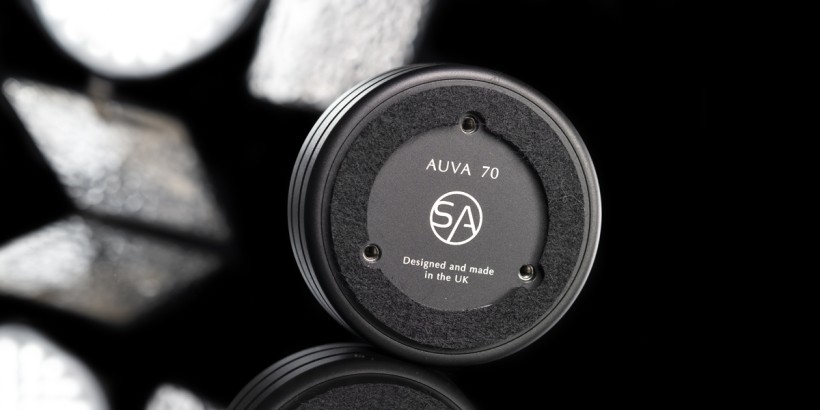
 The Auva 70 is a vibration isolator with a diameter of 70 mm and, beneath its compact exterior, a rather elaborate internal structure. Each footer incorporates three particle-filled chambers that dissipate vibrational energy through collisions between the particles, converting kinetic energy into heat rather than storing it or allowing rebound. The effect can be likened to a golf ball hitting sand at high velocity: the energy is absorbed almost instantly, with no bounce back. The chambers are tuned to handle a broad spectrum of vibrational frequencies, and the isolator’s mass and geometry ensure stable mechanical contact and consistent load distribution. While most high-performance isolators allow for lateral movement, the Auva 70 relies entirely on particle motion and friction, making it quite unique. Its aluminium casing and absence of moving parts give it an extremely robust feel in the hand while maintaining dimensional stability under load. The top features a threaded M8 receiver for secure attachment to loudspeakers, and the underside, busy with felt pads, also includes openings for optional spikes—handy on carpeted surfaces. Each Auva 70 can support up to 70 kg individually, meaning a quad can handle approximately 280 kg, providing stability even under very heavy loudspeakers. While noticeably larger than the LessLoss Giant Steps and sound|kaos Vibra 30, today’s design is more compact than the sound|kaos Vibra 68 and Carbide Audio’s Bases and Micros. It is exceptionally well made and arrives in a cushioned foamy box that holds four units. The attention to detail is evident, though after seeing the Stack Audio site, I didn’t expect anything less. Now it’s time to take the Auva lot for a spin.
 Most anti-vibration accessories I review end up under speakers or electronics, but the Auva 70 footers demanded a different approach: designed specifically for the former, they forced me to narrow my scope. Two quads of these British footers were enough to fully arm the sound|kaos Vox monitors on their squared brass bases, atop as many Vibra 68 isolators serving as today’s main sparring partners. Evaluating the Auva 70 required a careful back-and-forth: first listening with them on duty, then swapping back to my reference sound|kaos pucks, rinse and repeat until all sixteen footers had been rotated, and as many times as necessary. The process was neither quick nor easy, yet with each swap it became smoother—a reminder that practice makes perfect, even with something as seemingly simple as undoing bolts.
 First, let’s consider how a potent decoupling device can influence speaker performance. Early on, its presence often manifests as a subtle drop in apparent volume, almost as if the system had taken a small step back. Then come more tangible changes: bass extends deeper, gains speed, substance, and authority, becoming more anchored, defined, composed, powerful, elastic, and dynamically eager. In the process, any residual hollowness or boominess that reinforces room chatter is noticeably reduced. Vocals shed excess edginess and grain, gaining color, density, smoothness, and articulation, with outlines rendered more precisely. The backdrop grows darker, cleaner, more engaging, and richer in nuanced detail that becomes easier to follow. The soundstage expands, develops additional layers, and increases in complexity, while all sources remain in focus, expressive, and contrasting. Many anti-vibration devices I’ve sampled deliver these foundational improvements without major compromises, but they don’t sound the same, and the crucial difference lies in their efficacy. The higher it is, the easier it becomes for our ears to register and appreciate the changes listed above. In this context, the Auva 70 footers do a lot and tick all the checkboxes without miss—but that description alone still falls short. To fully understand their impact, a broader context is needed.
 The Vox monitors I’ve been using as my reference since mid-2020 have largely lived on quality aftermarket footers. In late 2021, their maker’s stock washers were replaced first with Carbide Audio Bases and later with their higher-tiered Diamond versions. While supremely effective with the Vox, these isolators were visually bulky and somewhat out of proportion under this Swiss load. I didn’t mind—after all, the largest Carbide isolators excelled in performance—but there was a practical issue: although they could technically bolt to the Vox bases, the extra weight made lifting and repositioning the monitors in my listening room—a frequent task—far more difficult than it should be. To mitigate this, I equipped the Carbide Bases with TwinDamp spikes at their topmost points and placed the Vox directly on their tips, which meant that every repositioning exercise involved moving six large pucks, seating the monitors atop them, dialing in alignment, and only then listening. I had grown used to the hassle and could have lived with it, yet I wouldn’t have minded a lighter, more compact footer capable of matching the largest Carbides’ sonic performance in their Diamond form. Finding such a solution proved tricky—until it wasn’t. One year ago, the sound|kaos Vibra 68 footers replaced the Carbide Bases for precisely the right reasons.
 While the Carbide Base Diamond footers under the Vox were extremely effective, the Vibra 68 quickly proved themselves equal in this setup—so much so that I came to consider them comparable in many ways. Both isolators exhibited all the traits outlined earlier, making Martin Gateley’s more affordable design a major overachiever. I didn’t detect meaningful differences in imaging size, saturation, smoothness, clarity, or other key aspects—only in bass. The Vibra 68 delivered a leaner yet more guttural and precise low end, sensibly stronger and rawer, while the Base was fuller, rounder, and more relaxed, as one might expect from its viscoelastic-ring infusion. These were easily traceable differences, but by no means radical overhauls, offering no reason to single out a superior specimen. Both were highly accomplished where it mattered, which spoke volumes about the Swiss footer’s performance caliber. While the Vibra 68 pucks didn’t offer a clear sonic upgrade over the diamond-tiered Bases per se, they replaced the latter due to one decisive advantage: their practicality, expressed as far greater ease of use with the Vox. I’ve been running Vibra 68 under these monitors ever since, never looking back. If it ain’t broken, don’t fix it. With that lay of the land, we can now move on to the Auva 70.
 While the Carbide and sound|kaos isolators, by design, allowed for some mechanical play under the Vox, the Auva 70 bolted directly to their bases did not. The connection these newcomer pucks made with my reference speakers was as firm as it gets. That, however, wasn’t a reliable predictor of any particular sonic outcome. In anti-vibration terms, assuming that floating isolators sound unstable would be misguided; in practice, the opposite is often true. The very best examples I’ve sampled all permit a degree of lateral movement, hardly by coincidence. Against that backdrop, the Auva 70 stands apart as a rock-solid solution and the first of its particle-damping kind I’ve had the pleasure of using. It also made clear, very quickly, that the link between its structural solidity and its perceived aural robustness is very much a thing—one of many to come, all of them desirable.
 To start easy and casually wake my system after several days of hiatus, I cued up Jon Lord’s track “Miles Away.” The DSD version sounds wonderfully analog-like, exactly as dense 1-bit data should. The tune is packed with real instruments, layered deep into the soundstage, many of which aren’t shoved at the listener but gently presented, creating a flow that’s both relaxed and richly detailed. While I don’t typically listen to music in the background, “Miles Away” has everything you need to enjoy it while doing something else—in my case, organizing the Vibra 68 footers for the upcoming back-and-forth sessions. Around the 1:20 mark, several soft drum accents appear. With the sound|kaos footers in place, my attention never settled on this element. The Auva 70, however, immediately pulled it into focus—clearly enough to register even while I was more engaged in manual tasks than in critical listening. From a reader’s perspective, this might sound like nothing more than a reviewer indulging in colored storytelling. To me, though, the moment was both telling and meaningful. I sat down, committed fully to music intake, and finally got my answers.
 The track was just one of many where the Auva 70 flaunted its exemplary insight into the music; high-tiered resolution as the natural byproduct of exceptional detail retrieval. Many effective anti-vibration accessories achieved that to some degree, but the fundamental distinction of the Auva 70 lay in the drum’s fleshy, tonally rich presence. It felt like a more tangible, touchable instrument altogether, and that was the core of my initial observation. I simply had to sit down, have my full attention on listening, and then translate the experience into words. By contrast, the Vibra 68 kept pace on articulation, yet their rendition of the same drum sounded slightly more distant, and with less tonal intensity, which explains why it didn’t register with as much of an impact. To further explore the subject of tone, I turned to “Finale” from Mike Oldfield’s Tubular Bells 2003. While seemingly innocuous at first, the piece gradually builds momentum before culminating in a dramatic, dynamically broad large-scale climax. Led by an easily traceable bass guitar line, the track revealed another strength of the Auva 70: with the Vox monitors resting atop them, the bass and several accompanying instruments carried noticeably greater weight than I was accustomed to. As a result, the entire presentation felt more anchored and grounded than it did with two quads of the larger Vibra footers.
  At that point, some would ask whether the sensibly dense and earthy perspective delivered by the Auva 70 was more true to the real thing than the Vibra 68’s leaner take. Or perhaps it was the other way around? Beats me—and honestly, I couldn’t care less. What mattered to me was that the Auva 70 injected a particular kind of tonal intensity, fruitiness, elasticity, and tactile presence that greatly enriched a large portion of my daily music diet. I suspect that, in his own Auva 70 review, Srajan had some of these qualities in mind. That today’s footers achieved all this while remaining supremely fluent in resolution and clarity—that was their special trait, and a real boon for me as a listener. By contrast, the Vibra 68 leaned slightly more toward articulation and outline specificity, and that grooming made them, in practice, a touch icier, sunnier, lighter, and tenser than the Auva 70.
 Past the introductory courtesies, it was time to engage party mode and cue up some bass-intensive fare at high volume. Enter “Keep It Together” by How to Destroy Angels, followed by the same band’s “Parasite”, and then Eivør Pálsdóttir’s “Tròdlabùndin”. Across all three tracks, the Auva 70 dug perceptibly deeper, delivering bass that was bloomier, fuller, and more voluminous—yet simultaneously more controlled, commanding, guttural, and harder-hitting. By my standards, this behavior was as unusual as it was counterintuitive. Low frequencies that present as round and warm are typically looser, more relaxed, even lazy. Not today. Truth be told, nothing about the Auva 70s’ performance under Vox monitors was plainly voluptuous or warm. If anything, these footers went about their business with a moist, elastic, and lively feel more than anything else. With the Vibra 68, the picture immediately became more mechanical, technical, and light-legged—though those pucks, in isolation, are not inherently voiced that way. Perspective, however, is everything, and the Auva 70 offered a distinct one—brilliantly executed at that. Of all the footers in my flock, Carbide Bases deliver the most voluptuous, beefy, and warm bass. Carbide Micros sit at the opposite extreme, sounding lean, accelerated, punctual, and dynamically charged. The sound|kaos Vibra 68, and their smaller Vibra 30 siblings, position themselves somewhere between those two poles. The Auva 70, meanwhile, largely follow the Carbide Bases in terms of density, while staying closer to the Carbide Micros in energy delivery, firmness, dynamic span, timing, and immediacy. Already unique on that basis alone, these newcomer isolators also raise the bar on one additional front.
 In many of my reviews, I have praised the Vox monitors for their spatially fiendish behavior when positioned close to the listening seat with ample space behind them. Even atop the stock washers, this already reflects their intended character. Aftermarket footers, however, consistently reveal just how far this foundational trait can be taken. While the isolators at my disposal typically enhance backdrop blackness and imaging scale as much as color saturation and resolution, the Auva 70 advanced spatial qualities in a distinctly individual way. With the Vox monitors resting on these British pucks, the soundstage expanded into something larger and more enveloping than with the Vibra 68. Instrumental and vocal images became less overtly technical yet more three-dimensional, texturally ripe, touchable, and ultimately lifelike. Nothing in this presentation felt out of balance. Instead, the high-tier elasticity so clearly exhibited by the Auva 70 under the Vox speakers acted as connective tissue, binding everything into an exceptionally fluid whole. The result was a spectacle as richly saturated with color as it was intelligible in its delivery. Suchness is the best word in my vocabulary to do describe the feeling. If today’s subject were a DAC, a finely voiced R-2R ladder design with DHT-infused outputs and EI transformers would be the closest analogy I could draw. Much like the Audio Reveal Hercules D/A converter impressed last year with its big tone, openness, elasticity, and energy, the Auva 70 delivered those same virtues here and now. In other words: what a find. Let’s wrap.


Before the Auva 70 landed in my listening room, I was convinced a top-tier anti-vibration accessory needed a bit of lateral play. It proved me spectacularly wrong. Every bit as potent as the other isolators in my arsenal, it does all this without a single moving part—which, let me stress, is proper wickedness in its own right. Mechanically robust and visually understated, it whispers quiet-luxury competence without ever needing to brag. Elegant design, upper-echelon performance, and a very competitve price leave nothing to gripe about—not even the Auva 70’s tasteful, self-assured style. Tip of the hat to Team Stack Audio for conjuring this nifty little thing and charging it with such might and confidence.
Associated Equipment:
- Amplifier: Trilogy 995R, FirstWatt F7, Enleum AMP-23R
- DAC: LampizatOr Horizon360 (Stradi 5U4G + Psvane Summit 4x KT88 / 2x 6SN7)
- Speakers: Boenicke Audio W11 SE+, sound|kaos Vox 3afw
- Transport: Innuos Statement, fidata HFAS1-S10U
- Preamplifier: Trilogy 915R, Thöress DFP
- Speaker cables: Boenicke Audio S3, LessLoss C-MARC
- Headphones: HifiMan Susvara Unveiled, Campfire Audio Cascade, Vision Ears VE5
- Speaker signal conditioning: LessLoss Firewall for Loudspeakers, Boenicke ComDev
- Anti-vibration conditioning: 6x Carbide Base Diamond (under streamer), 6x Carbide Base Micro Diamond with TwinDamp inserts and spikes (under DAC and pre), Vibra 68 (under speakers), 12x LessLoss Giant Steps (under streamer, DAC and pre)
- Interconnects: LessLoss Entropic Process C-MARC, Boenicke Audio IC3 CG
- Power components: Gigawatt PC-3 SE EVO+/LC-3 EVO, LessLoss C-MARC, LessLoss Entropic C-MARC, LessLoss Stellar C-MARC, LessLoss Power Distributor into Boenicke Audio Power Gate, ISOL-8 Prometheus
- USB components: AudioPhonique Desire USB
- Rack: Franc Audio Accesories Wood Block Rack 1+3
- Network: Fidelizer EtherStream, Linksys WRT160N
- Music: NativeDSD
Retail prices of reviewed components in EU (incl. VAT):
- Stack Audio Auva 70: €987/8
Manufacturer: Stack Audio